Showing posts with label Banks. Show all posts

Thursday, November 26, 2009

Wall of Awesome


Main Entry: Wall of Awe·some
Function: noun
Definition: a wall set aside for displaying awesome student work
Eatamology: Merced (co-teacher in 2007) and I first dreamed of the Wall of Awesome during a weeklong New Tech Training session in Bloomington, Indiana back in 2007. We dreamed of a place to display student work that satisfied rubric criteria that was more advanced than Advanced criteria. We got so busy with our first year at MNTH that we never implemented in idea. This Fall 2009, Banks (current co-teacher) and I figured out how to implement the Wall of Awesome – see below.
Date: Summer 2007, Fall 2009

At MNTH, most project products are graded using 3 column rubrics. The three columns are Emerging or Unsatisfactory, Proficient, and Advanced or Exemplary. Students can earn up to high B’s by completing all the Proficient criteria correctly and up to high A’s by completing all the Proficient and Advanced criteria. This is a simple scheme when students complete ALL the proficient criteria BEFORE attempting the Advanced criteria. Often they don’t do this. Instead teams often partially complete items from both columns and assigning A’s and B’s becomes much less straightforward.

Banks and I figured out a solution to this. We do not allow teams to view the Advanced criteria unless they complete all the Proficient criteria several days before the final product is due. Teams that apply for the Advanced rubrics also have the option to apply for the Awesome rubrics. Both Advanced and Awesome rubrics allow teams to earn up to 100% on their final products. Awesome is more challenging than Advanced. Teams that apply for Awesome have to attend invitation-only workshops on enrichment material in order to complete all the Awesome criteria. Teams going for Advanced can complete the Advanced material based on workshops and learning activities accessible to all teams. Although Awesome is more challenging than Advanced, we do not give out extra-credit points to teams that complete the Awesome criteria. Instead, we reward these teams by creating slides of their team members and their work that hang up on the Wall of Awesome for the entire year.

Having an application process for Advanced/Awesome rubrics has encouraged many teams to avoid leaving project work until the day before major deadlines. Many teams who apply for Advanced/Awesome rubrics choose the Awesome rubric even though they know it’s harder. Some students who have already made it on the wall have set higher goals for themselves in the course because they believe they should be awesome if they are on the Wall of Awesome.

Wednesday, November 25, 2009

Work Suites


Main Entry: work suite
Function: noun
Definition: a section of a classroom that is set aside as a work area for a single project team
Eatamology: Last year, I finally decided to officially mark the 8 work suites in my room using parody prints of Ugly Dolls in famous paintings that I created in Notebook. Kevin Gant and Michael McDowell, two very talented and wise New Tech coaches, have often stressed the importance of displaying the group contracts in places that are easily accessible to teams. Tara Craig (co-teacher from last year) and I started hanging up their group contracts within their suites. This year, my current co-teacher Mr. Banks added his own personal touch to each work suite by hanging up PVC pipes to hold the know/need-to-know charts and team contracts for the teams that occupy each work suite.
Date: Summer 2008 (First time It sunk in my brain that group contracts must be constantly visible – I probably heard this as early as Summer 2007 but it didn’t sink until 2008) Fall 2008 (work suites adorned with ugly doll paintings and group contracts), Nov. 15 2009 (Banks installs PVC pipes to hold contracts and other team docs)

Having designated work areas for different teams is a key part of the design of my classroom that helps me to facilitate PBL teams. I do not use individual seating charts because all my students work in teams. Instead, I assign work suites to teams of 2 or 3 students that consist of 2 or 3 adjacent work stations with a team set of textbooks. Within the work suite, the students can sit wherever they like.

Each work suite has a place that holds the team contracts and know-need-to-know charts of the teams that occupy that suite. In our newest scheme, the group contracts hang above the work station that is in the center of the work suite. Since 4 teams from 4 different periods share the work suite, the group contracts are color-coded (pink = Period 1, goldenrod = Period 2, green = Period 3, blue = Period 4). When the teams start each period, they flip the pages in the work suite displays until their team contract is at the front of the display.

Having the group contract in an accessible place makes it easy for me to reference the team contract whenever I am coaching teams to refocus or to peacefully resolve conflicts. The group contracts always set nice starting points for these conversations. If they are not detailed enough to solve the problem at hand, I ask the teams to add addendums to their contracts that include strategies and new agreements to solve current team issues/conflicts.

Some of my high functioning teams reference the contract on their own when their teams hit bumpy spots and high points (during high points, my teams celebrate and these celebrations are documented in their contracts – the idea of team celebrations was eaten out of Michael McDowell’s brain). Sometimes I scaffold reflections on their contract into their work days by adding prompts in their warm-ups that reference agreements in their team contracts. Having the group contracts close at hand, makes it easy for my teams to complete these reflections.

Tuesday, November 24, 2009

Moustaches


Phylgebrics Teachers, Mr. Banks (Algebra 2) and Dr. T (Physics), sporting moustaches on the Stuntkid Presentation Day

Main Entry: mous·tach·es
Function: Noun
Definition
: a strip of hair above the upper lip. Also, an example of presentation flair (a prop that helps inspire students during presentations).
Eatamology: Eaten out of my co-teacher, Mr. Banks brain. The moustaches matched the Stuntkid theme of our Stuntkid project. He started buying moustaches in preparation for presentation day – so I matched his purchases so all our students could present with moustaches.
Date: First purchase date: 10/31 or 11/1/09 Presentation dates: 11/4/09-11/5/09

Banks and I have lots of brainstorming sessions where lots of crazy ideas are proposed, discarded, polished, etc. I thought the moustache idea was just going to be one of our crazy daydream ideas until Banks starting buying moustaches. It turns out that they weren’t that expensive at Party City.

The kids kept asking if it would be extra-credit to wear moustaches. We did not give out extra-credit for wearing moustaches because the moustaches were not about grades. They were about having more fun while presenting. Some of the students wore the moustaches throughout the day and it created a positive buzz throughout the school. By mid-day, our principal was wearing a moustache. Some students improvised and used the moustaches to create goaties, large eyebows, and unibrows.

It was a silly idea – that turned out to be brilliant. So far, I think the Stuntkid presentations are the best presentations I’ve ever facilitated because of the mustaches and another strategy (which I will describe in a future blog entry).

Monday, November 23, 2009

The Bank of Phylgebrics


Main Entry
: Fake Bank
Function: Noun
Definition: Fake banks hold fake money earned by project teams. Teams use the fake money to purchase materials for their projects.
Eatamology: Originally eaten out of Bert Bassett & Ruth Burrell brains (two very creative teachers from the first Think Forward Cohort). These teachers helped me to begin brainstorming this scheme while they were developing a similar point scheme for an integrated middle school math/ELA project. Since then, my co-teacher (Mr. Banks) and I have implemented the idea in our current project. We are developing tools and rules to manage the bank as we go along.
Date: November 5, 2009 to present

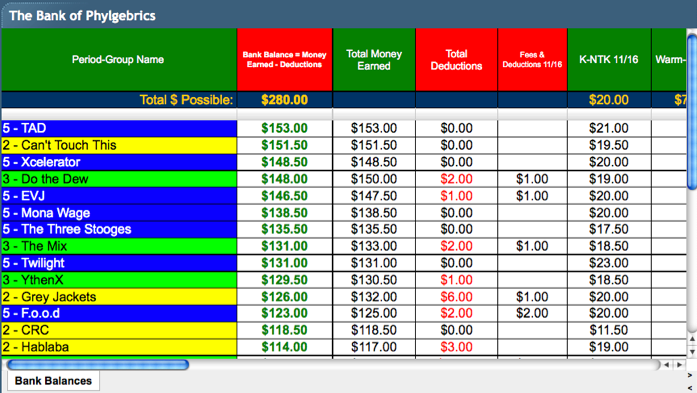
We were going to create fake money with Mr. Bank’s face on it because it’s a shame to not cash in on a name like Banks. Due to lack of time and our tendency to conserve paper whenever it is at all possible, we went with an online banking model. The Bank of Phylgebrics is a Google spreadsheet that is embedded into one of the pages of the Google site that holds our Rollercoaster project materials.

To protect students’ information, there are no individual grades or individual names in the Bank. Instead, the bank holds team names and team dollar deposits (these deposits are similar but in many cases different from the actual grades of the assignment/assessment scores generating the cash). Teams earn cash by completing team assignments and by helping individuals in their teams to submit individual assignments. All individual assignment scores are converted to cash via rules that involve team averages.

Teams lose points for not following classroom norms regarding tardies, materials maintenance, appropriate use of technology, respectful behavior, etc ... The tardy fees are motivating our students to apply positive peer pressure to get their peers into class on time and to live by classroom norms. The cleaning fees are keeping most of the work suites in our classroom in very good condition throughout the day. Even though the money is fake, being able to charge cleaning fees whenever I clean up work suites is very therapeutic for me. I did not go to graduate school to become a maid. Now I’m a part-time maid who makes a lot of fake cash – this is more fun than it sounds.

Teams use the fake money to buy materials. In phase one of the Rollercoaster project, our teams are buying marketing packages that they will use to sell their rollercoasters to teams in a different course at our school, PLTW Principles of Engineering (POE). Because our teams will not be given any face-to-face time with the POE teams, having a good marketing package is crucial to selling their rollercoaster designs. The bargain package allows teams to use text-only Google docs to market their designs. The standard package allows teams to use Google docs with text and pictures. The deluxe package allows teams to use Google docs or Google sites with text, pictures, and embedded simulations and videos.

Teams that succeed in selling their rollercoasters will earn a lot of fake money which they can use to buy the materials to build their prototypes. Also the rollercoasters that are selected by the POE project managers will be rendered in Autocad Inventor and will be built on an impressive scale by POE teams. These models will be mounted to the walls of one (or maybe two) of the POE classrooms.

Teams that fail to earn enough money to buy the cheapest package (bargain package) will go into fake debt and will be charged an overdraft fee (the overdraft idea is all Mr. Banks – it’s harsh but very real world).

Some of our teams are very motivated by the banking scheme. We list team balances in order of highest to lowest balances so the teams near the top are working very hard to stay within the top 5 or 10 teams. Some teams near the bottom are being much more assertive about going through processes that penalize (and eventually fire) non-contributing group members. I think this is happening because the fake budgets create fake stress. Since the grades are different from the budgets, it’s possible for students to earn A’s in the course based on their own efforts and still have very poor bank balances because team averages are being used to generate the balances.